MROP vs GROL - What's the Difference?
Both are FCC commercial radio licenses, but one is for operating marine radios and the other lets you work on the transmitters. Here's which one you need.
By Dragan Pecanac, aircraft maintenance technician and former USAF avionics technician
The Short Version
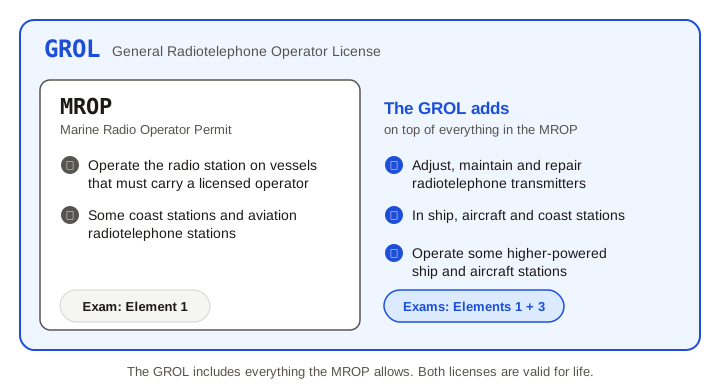
The Marine Radio Operator Permit (MROP) lets you operate radio stations on vessels that are required to have a licensed operator.
The General Radiotelephone Operator License (GROL) lets you do everything the MROP allows, and it also lets you adjust, maintain and repair the transmitters in ship, aircraft and coast stations. That's why avionics and marine electronics technicians hold one.
If you run a radio, the MROP is enough. If you repair them, you need the GROL.
The MROP
The MROP is the entry-level marine operator license. You need it to operate the radiotelephone station on:
- •Vessels of more than 300 gross tons
- •Vessels carrying more than six passengers for hire on the open sea or US tidewaters
- •Certain vessels on the Great Lakes
It also covers certain coast stations and some aviation radiotelephone stations.
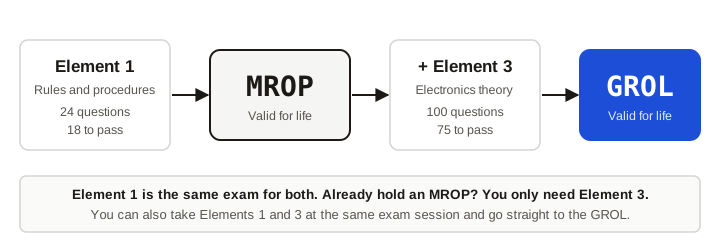
The exam is Element 1: 24 questions from a public pool of 144, covering marine radio rules, operating procedures, equipment and GMDSS. You need 18 right (75%).
A common mix-up: a recreational boat sailing to a foreign port doesn't need an MROP. That usually takes the Restricted Radiotelephone Operator Permit, which has no exam.
The GROL
The GROL is the FCC's general technician license. On top of everything the MROP allows, it authorizes you to adjust, maintain and internally repair FCC-licensed radiotelephone transmitters in the maritime, aviation and international fixed public services. It's also required to operate some higher-powered ship and aircraft stations.
The GROL takes two exams:
- •Element 1: the same 24-question rules exam as the MROP
- •Element 3: 100 technical questions on electronics fundamentals, circuits, transmitters, receivers, antennas, radar and navigation aids. You need 75 right.
Element 3 is the hard part. It's real electronics theory, with Ohm's law, resonance, amplifier classes and modulation.
Side by Side
| MROP | GROL | |
|---|---|---|
| Exams | Element 1 | Elements 1 and 3 |
| Questions | 24 | 124 (24 + 100) |
| To pass | 18 of 24 | 18 of 24, and 75 of 100 |
| Operate required marine stations | Yes | Yes |
| Adjust and repair transmitters | No | Yes |
| Math on the exam | Almost none | A fair amount |
| Valid for | Life | Life |
Which One Should You Get?
The MROP is enough if you: - Work as captain or crew on a passenger vessel or a large commercial vessel - Need a licensed operator for the radio, but not someone to repair it - Want the quickest way to meet a job requirement
Go for the GROL if you: - Install, tune or repair marine or aviation radios, or want to - Work, or plan to work, as an avionics or marine electronics technician - See job listings that ask for an "FCC license", which almost always means the GROL
The MROP Is a Stepping Stone
If you already hold an MROP, you don't take Element 1 again. You pass Element 3 and upgrade to a GROL. Lots of people start with the MROP because it's quick, then come back for the GROL when a job needs it.
Where to Start
Hangar Academy's MROP course is free with an account, and it covers all of Element 1. When you're ready for Element 3, the GROL course adds the technical half: study chapters with diagrams, the full question pool, and mock exams scored per element like the real test.